50-105-38
CD101 Monoclonal Antibody (Moushi101), PE, eBioscience™, Invitrogen™
Manufacturer: Fischer Scientific
Select a Size
| Pack Size | SKU | Availability | Price |
|---|---|---|---|
| Each of 1 | 50-105-38-Each-of-1 | In Stock | ₹ 30,349.00 |
50-105-38 - Each of 1
In Stock
Quantity
1
Base Price: ₹ 30,349.00
GST (18%): ₹ 5,462.82
Total Price: ₹ 35,811.82
Antigen
CD101
Classification
Monoclonal
Concentration
0.2 mg/mL
Formulation
PBS with 0.09% sodium azide; pH 7.2
Gene Accession No.
A8E0Y8
Gene Symbols
CD101
Purification Method
Affinity chromatography
Regulatory Status
RUO
Gene ID (Entrez)
630146
Content And Storage
4° C, store in dark, DO NOT FREEZE!
Form
Liquid
Applications
Flow Cytometry
Clone
Moushi101
Conjugate
PE
Gene
CD101
Gene Alias
Cd101; CD101 antigen; CD101 molecule; cell surface glycoprotein V7; EWI immunoglobulin subfamily member EWI-101; EWI101; EWI-101; Glu-Trp-Ile EWI motif-containing protein 101; Gm1016; Gm734; IGSF2; Immunoglobulin superfamily member 2; immunoglobulin superfamily, member 2; leukocyte surface protein; RP11-27K13.2; V7
Host Species
Rat
Quantity
100 μg
Primary or Secondary
Primary
Target Species
Mouse
Product Type
Antibody
Isotype
IgG2a κ
Related Products

Description
- Description: The monoclonal antibody moushi101 recognizes mouse CD101, also known as IGSF2 and V7 (7 IgV domains)
- CD101 is a transmembrane glycoprotein containing 7 Ig-like IgV domains and a short cytoplasmic tail with several phosphorylation sites
- Cross-linking CD101 can antagonize TCR/CD3-mediated lymphocyte activation
- CD101 is expressed on monocytes, granulocytes, dendritic cells, Langerhans cells and activated T cells
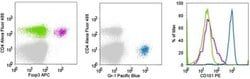
- In addition, CD101 is found on a subset of CD25+Foxp3+ T regulatory cells that showed higher suppressive properties in vitro and in vivo
- Applications Reported: This Moushi101 antibody has been reported for use in flow cytometric analysis
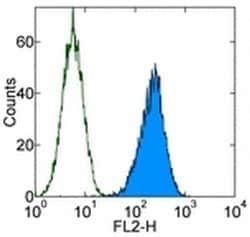
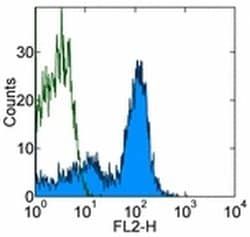
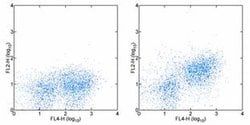
- Applications Tested: This Moushi101 antibody has been tested by flow cytometric analysis of mouse splenocytes
- This can be used at less than or equal to 0.25 μg per test
- A test is defined as the amount (μg) of antibody that will stain a cell sample in a final volume of 100 μL
- Cell number should be determined empirically but can range from 10^5 to 10^8 cells/test
- It is recommended that the antibody be carefully titrated for optimal performance in the assay of interest
- Excitation: 488-561 nm; Emission: 578 nm; Laser: Blue Laser, Green Laser, Yellow-Green Laser
- Filtration: 0.2 μm post-manufacturing filtered
- CD101 also known as V7 antigen, a member of the Ig superfamily
- CD101 is a disulfide linked homodimer of unknown function
- Expression of CD101 is found on monocytes, granulocytes and dendritic cells (Langerhan-like cells HLA-DR, CD1a, CD1c)
- In addition expression on T lymphocytes is important for cell activation
- CD101+ CD28+ cells are very responsive to CD28 signaling
- In combination with anti-CD28 or suboptimal levels of anti-CD3, anti-CD101 can increase proliferation thereby suggesting an activating role
- The monoclonal antibody BB27 has been shown to inhibit the T cell reactivity in allogeneic and antigen-specific mixed DC-T cell cultures
- Recently it has been demonstrated that mouse CD101 is found on a subpopulation of regulatory T cells (CD4, CD25, Foxp3 positive) that have high suppressor activity
- Expression of CD101 on human PBMCs shows staining of about 30% of the Foxp3 positive cells
- Studies have not confirmed higher suppressor activity in the human CD101 population.