CD53 Antibody (63-5A3), Novus Biologicals™
Mouse Monoclonal Antibody
Manufacturer: Fischer Scientific
The price for this product is unavailable. Please request a quote
Antigen
CD53
Concentration
0.2 mg/mL
Applications
Flow Cytometry, SDS-Page, Immunofluorescence
Conjugate
Unconjugated
Host Species
Mouse
Research Discipline
Immunology
Formulation
10mM PBS and 0.05% BSA with 0.05% Sodium Azide
Gene ID (Entrez)
963
Immunogen
Human Sezary cells
Primary or Secondary
Primary
Content And Storage
Store at 4C.
Clone
63-5A3
Dilution
Flow Cytometry 0.5 - 1 ug/million cells in 0.1 ml, SDS-Page, Immunofluorescence 0.5 - 1.0 ug/ml
Classification
Monoclonal
Form
Purified
Regulatory Status
RUO
Target Species
Human
Gene Alias
antigen MOX44 identified by monoclonal MRC-OX44, CD53 antigentetraspanin-25, CD53 glycoprotein, CD53 molecule, CD53 tetraspan antigen, cell surface antigen, Cell surface glycoprotein CD53, MOX44transmembrane glycoprotein, Tetraspanin-25, tspan-25, TSPAN25leukocyte surface antigen CD53
Gene Symbols
CD53
Isotype
IgG2b κ
Purification Method
Protein A or G purified
Test Specificity
Recognizes a protein of 33-55kDa, identified as CD53 (Workshop V; Code CD53.1). CD53 is expressed on monocytes, and macrophages, granulocytes, dendritic cells, osteoblasts and osteoclasts, NK cells, and on T- and B-cells from every stage of differentiation but is absent from platelets, erythrocytes, and non-haemopoietic cells. CD53 is a member of a family of tetraspan transmembrane proteins, including CD9, CD37, CD63, CD81, and CD82. It associates with integrins, MHC class II molecules, and a tyrosine phosphatase and plays a role in cellular activation as part of a signal transduction complex involving other membrane glycoproteins. Defects of CD53 expression on neutrophils appear to be related with recurrent infectious diseases. Cross-linking CD53 using CD53 antibodies led to cytoplasmic calcium fluxes in B cells, monocytes, and granulocytes and activation of the monocyte oxidative burst.
Related Products


Description
- Ensure accurate, reproducible results in Flow Cytometry, Immunofluorescence CD53 Monoclonal specifically detects CD53 in Human samples
- It is validated for Flow Cytometry, Immunocytochemistry/Immunofluorescence, Functional, Immunofluorescence.
Compare Similar Items
Show Difference
Antigen: CD53
Concentration: 0.2 mg/mL
Applications: Flow Cytometry, SDS-Page, Immunofluorescence
Conjugate: Unconjugated
Host Species: Mouse
Research Discipline: Immunology
Formulation: 10mM PBS and 0.05% BSA with 0.05% Sodium Azide
Gene ID (Entrez): 963
Immunogen: Human Sezary cells
Primary or Secondary: Primary
Content And Storage: Store at 4C.
Clone: 63-5A3
Dilution: Flow Cytometry 0.5 - 1 ug/million cells in 0.1 ml, SDS-Page, Immunofluorescence 0.5 - 1.0 ug/ml
Classification: Monoclonal
Form: Purified
Regulatory Status: RUO
Target Species: Human
Gene Alias: antigen MOX44 identified by monoclonal MRC-OX44, CD53 antigentetraspanin-25, CD53 glycoprotein, CD53 molecule, CD53 tetraspan antigen, cell surface antigen, Cell surface glycoprotein CD53, MOX44transmembrane glycoprotein, Tetraspanin-25, tspan-25, TSPAN25leukocyte surface antigen CD53
Gene Symbols: CD53
Isotype: IgG2b κ
Purification Method: Protein A or G purified
Test Specificity: Recognizes a protein of 33-55kDa, identified as CD53 (Workshop V; Code CD53.1). CD53 is expressed on monocytes, and macrophages, granulocytes, dendritic cells, osteoblasts and osteoclasts, NK cells, and on T- and B-cells from every stage of differentiation but is absent from platelets, erythrocytes, and non-haemopoietic cells. CD53 is a member of a family of tetraspan transmembrane proteins, including CD9, CD37, CD63, CD81, and CD82. It associates with integrins, MHC class II molecules, and a tyrosine phosphatase and plays a role in cellular activation as part of a signal transduction complex involving other membrane glycoproteins. Defects of CD53 expression on neutrophils appear to be related with recurrent infectious diseases. Cross-linking CD53 using CD53 antibodies led to cytoplasmic calcium fluxes in B cells, monocytes, and granulocytes and activation of the monocyte oxidative burst.
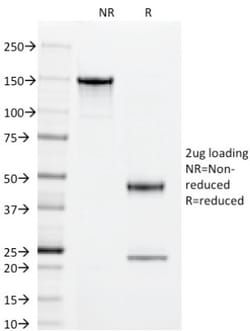
Antigen: CD55/DAF
Concentration: 0.2 mg/mL
Applications: Flow Cytometry, Immunohistochemistry (Frozen), SDS-Page, Immunofluorescence
Conjugate: Unconjugated
Host Species: Mouse
Research Discipline: Immunology
Formulation: 10mM PBS and 0.05% BSA with 0.05% Sodium Azide
Gene ID (Entrez): 1604
Immunogen: PHA stimulated human PBL
Primary or Secondary: Primary
Content And Storage: Store at 4C.
Clone: 143-30
Dilution: Flow Cytometry 0.5 - 1 ug/million cells in 0.1 ml, Immunohistochemistry-Frozen 0.5 - 1.0 ug/ml, SDS-Page, Immunofluorescence 0.5 - 1.0 ug/ml
Classification: Monoclonal
Form: Purified
Regulatory Status: RUO
Target Species: Human
Gene Alias: CD55 antigen, CD55 molecule, decay accelerating factor for complement (Cromer blood group), CRdecay accelerating factor for complement (CD55, Cromer blood group system), CROMDAFcomplement decay-accelerating factor, decay accelerating factor for complement, TC
Gene Symbols: CD55
Isotype: IgG1 κ
Purification Method: Protein A or G purified
Test Specificity: Recognizes a single chain glycoprotein of 70kDa, identified as CD55 (also known as decay accelerating factor, DAF). CD55/DAF is widely expressed on cells throughout the body including leukocytes, erythrocytes, epithelium, endothelium, and fibroblasts. It is a Glycosyl phosphatidylinositol anchored (GPI-anchored) member of the membrane bound complement regulatory proteins that inhibit autologous complement cascade activation. It prevents the amplification steps of the complement cascade by interfering with the assembly of the C3-convertases, C4b2a and C3bBb, and the C5-convertase, C4b2a3b and C3bBb3b. CD55 also serves as receptor for CD97 and for echovirus and Coxsackie B virus. The MAb 143-30 can be used as marker for paroxysmal nocturnal hemoglobinuria (PNH).
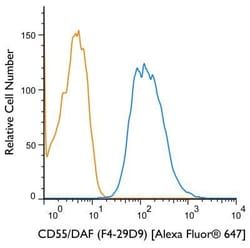
Antigen: CD55/DAF
Concentration: 0.2 mg/mL
Applications: Flow Cytometry, SDS-Page, Immunofluorescence
Conjugate: Unconjugated
Host Species: Mouse
Research Discipline: Immunology
Formulation: 10mM PBS and 0.05% BSA with 0.05% Sodium Azide
Gene ID (Entrez): 1604
Immunogen: Human umbilical vein endothelial cells (HUVEC)
Primary or Secondary: Primary
Content And Storage: Store at 4C.
Clone: F4-29D9
Dilution: Flow Cytometry 0.5 - 1 ug/million cells in 0.1 ml, SDS-Page, Immunofluorescence 0.5 - 1.0 ug/ml
Classification: Monoclonal
Form: Purified
Regulatory Status: RUO
Target Species: Human
Gene Alias: CD55 antigen, CD55 molecule, decay accelerating factor for complement (Cromer blood group), CRdecay accelerating factor for complement (CD55, Cromer blood group system), CROMDAFcomplement decay-accelerating factor, decay accelerating factor for complement, TC
Gene Symbols: CD55
Isotype: IgG1 κ
Purification Method: Protein A or G purified
Test Specificity: Recognizes a single chain glycoprotein of 70kDa, identified as CD55 (also known as decay accelerating factor, DAF). This MAb was clustered in Kobe at the Sixth International Workshop on Human Leukocyte Differentiation Antigens as F429D-9 (N-L120). CD55/DAF is widely expressed on cells throughout the body including leukocytes, erythrocytes, epithelium, endothelium, and fibroblasts. It is a Glycosyl phosphatidylinositol anchored (GPI-anchored) member of the membrane bound complement regulatory proteins that inhibit autologous complement cascade activation. It prevents the amplification steps of the complement cascade by interfering with the assembly of the C3-convertases, C4b2a and C3bBb, and the C5-convertase, C4b2a3b and C3bBb3b. CD55 also serves as receptor for CD97 and for echovirus and Coxsackie B virus. Anti-CD55 can be used as marker for paroxysmal nocturnal hemoglobinuria (PNH).