CD1d Monoclonal Antibody (1B1), Super Bright™ 600, eBioscience™, Invitrogen™
Manufacturer: eBioscience
Select a Size
| Pack Size | SKU | Availability | Price |
|---|---|---|---|
| Each of 1 | 63-001-182-Each-of-1 | In Stock | ₹ 31,773.00 |
63-001-182 - Each of 1
In Stock
Quantity
1
Base Price: ₹ 31,773.00
GST (18%): ₹ 5,719.14
Total Price: ₹ 37,492.14
Antigen
CD1d
Classification
Monoclonal
Concentration
0.2 mg/mL
Formulation
PBS with BSA and 0.09% sodium azide; pH 7.2
Gene Accession No.
P11609
Gene Symbols
Cd1d1
Purification Method
Affinity chromatography
Regulatory Status
RUO
Gene ID (Entrez)
12479
Content And Storage
4° C, store in dark, DO NOT FREEZE!
Form
Liquid
Applications
Flow Cytometry
Clone
1B1
Conjugate
Super Bright 600
Gene
Cd1d1
Gene Alias
AI747460; Antigen-presenting glycoprotein CD1d; antigen-presenting glycoprotein CD1d1; Cd1; CD1.1; CD1A; Cd1d; CD1D antigen; CD1D antigen, d polypeptide; CD1d molecule; CD1d.1; Cd1d1; CD1d1 antigen; CD1d1 molecule; differentiation antigen CD1-alpha-3; HMC class I antigen-like glycoprotein CD1D; Ly-38; R3; R3G1; T-cell surface glycoprotein CD1d; T-cell surface glycoprotein CD1d1; thymocyte antigen CD1D
Host Species
Rat
Quantity
100 μg
Primary or Secondary
Primary
Target Species
Mouse
Product Type
Antibody
Isotype
IgG2b κ
Description
- Description: The 1B1 monoclonal antibody reacts with mouse CD1d, a 48 kDa glycoprotein with structural homology to MHC class I molecules
- While similar to MHC Class I, CD1d associates with beta2m, functionally CD1d is similar to MHC Class II
- 1B1 detects CD1d at varying levels on mouse leukocytes
- 1B1 detects beta2m associated CD1d
- Applications Reported: The 1B1 antibody has been reported for use in flow cytometric analysis
- Applications Tested: The 1B1 antibody has been tested by flow cytometric analysis of mouse splenocytes
- This can be used at less than or equal to 0.25 μg per test
- A test is defined as the amount (μg) of antibody that will stain a cell sample in a final volume of 100 μL
- Cell number should be determined empirically but can range from 10^5 to 10^8 cells/test
- It is recommended that the antibody be carefully titrated for optimal performance in the assay of interest
- Super Bright 600 is a tandem dye that can be excited with the violet laser line (405 nm) and emits at 600 nm
- We recommend using a 610/20 bandpass filter
- Please make sure that your instrument is capable of detecting this fluorochrome
- When using two or more Super Bright dye-conjugated antibodies in a staining panel, it is recommended to use Super Bright Complete Staining Buffer (Product No
- SB-4401) to minimize any non-specific polymer interactions
- Please refer to the datasheet for Super Bright Staining Buffer for more information
- CD1d is a heavy chain associated with Beta 2 microglobulin on cortical thymocytes
- Beta 2 microglobulin independent expression of CD1d has also been demonstrated on human intestinal epithelial cells
- CD1d is the sole group 2 member of the CD1 family of major histocompatibility (MHC) like glycoproteins
- The CD1d gene encodes a divergent member of the CD1 family of transmembrane glycoproteins, which are structurally related to the major histocompatibility complex (MHC) proteins and form heterodimers with beta-2-microglobulin
- The CD1 proteins mediate the presentation of primarily lipid and glycolipid antigens of self or microbial origin to T cells
- The human genome contains five CD1 family genes organized in a cluster on chromosome 1
- The CD1 family members are thought to differ in their cellular localization and specificity for particular lipid ligands
- The protein encoded by the CD1d gene localizes to late endosomes and lysosomes via a tyrosine-based motif in the cytoplasmic tail
- Diseases associated with CD1D include Mycobacterium Malmoense and Autoimmune Disease.
Compare Similar Items
Show Difference

Antigen: CD1d
Classification: Monoclonal
Concentration: 0.2 mg/mL
Formulation: PBS with BSA and 0.09% sodium azide; pH 7.2
Gene Accession No.: P11609
Gene Symbols: Cd1d1
Purification Method: Affinity chromatography
Regulatory Status: RUO
Gene ID (Entrez): 12479
Content And Storage: 4° C, store in dark, DO NOT FREEZE!
Form: Liquid
Applications: Flow Cytometry
Clone: 1B1
Conjugate: Super Bright 600
Gene: Cd1d1
Gene Alias: AI747460; Antigen-presenting glycoprotein CD1d; antigen-presenting glycoprotein CD1d1; Cd1; CD1.1; CD1A; Cd1d; CD1D antigen; CD1D antigen, d polypeptide; CD1d molecule; CD1d.1; Cd1d1; CD1d1 antigen; CD1d1 molecule; differentiation antigen CD1-alpha-3; HMC class I antigen-like glycoprotein CD1D; Ly-38; R3; R3G1; T-cell surface glycoprotein CD1d; T-cell surface glycoprotein CD1d1; thymocyte antigen CD1D
Host Species: Rat
Quantity: 100 μg
Primary or Secondary: Primary
Target Species: Mouse
Product Type: Antibody
Isotype: IgG2b κ
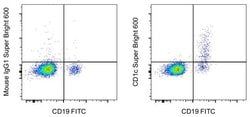
Antigen: CD1c
Classification: Monoclonal
Concentration: 5 μL/Test
Formulation: PBS with BSA and 0.09% sodium azide; pH 7.2
Gene Accession No.: P29017
Gene Symbols: CD1C
Purification Method: Affinity chromatography
Regulatory Status: RUO
Gene ID (Entrez): 911
Content And Storage: 4° C, store in dark, DO NOT FREEZE!
Form: Liquid
Applications: Flow Cytometry
Clone: L161
Conjugate: Super Bright 600
Gene: CD1C
Gene Alias: BDCA1; canCD1c; CD1; CD1A; CD1C; CD1C antigen, c polypeptide; CD1c molecule; cortical thymocyte antigen CD1C; differentiation antigen CD1-alpha-3; R7; RP11-101J8.3; T-cell surface glycoprotein CD1c
Host Species: Mouse
Quantity: 100 Tests
Primary or Secondary: Primary
Target Species: Human
Product Type: Antibody
Isotype: IgG1 κ
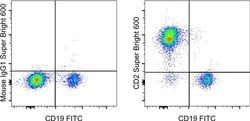
Antigen: CD2
Classification: Monoclonal
Concentration: 5 μL/Test
Formulation: PBS with BSA and 0.09% sodium azide; pH 7.2
Gene Accession No.: P06729, Q6SZ61
Gene Symbols: CD2
Purification Method: Affinity chromatography
Regulatory Status: RUO
Gene ID (Entrez): 100126712, 102120798, 396662, 449512, 677855, 914
Content And Storage: 4° C, store in dark, DO NOT FREEZE!
Form: Liquid
Applications: Flow Cytometry
Clone: RPA-2.10
Conjugate: Super Bright 600
Gene: CD2
Gene Alias: Cd2; CD2 antigen; CD2 antigen (p50), sheep red blood cell receptor; CD2 molecule; CD2R; cluster of differentiation 2; Erythrocyte receptor; FLJ46032; LFA2; LFA-2; LFA-3 receptor; Ly37; Ly-37; lymphocyte antigen 37; OX34; OX-34; OX-34 antigen; OX-45 surface antigen homolog to human T lymphocyte CD2 antigen; Rosette receptor; SRBC; surface immunoglobulin superfamily molecule; T11; T-cell surface antigen CD2; T-cell surface antigen T11/Leu-5
Host Species: Mouse
Quantity: 100 Tests
Primary or Secondary: Primary
Target Species: Baboon, Chimpanzee, Cynomolgus Monkey, Human, Non-human Primate, Porcine, Rhesus Monkey
Product Type: Antibody
Isotype: IgG1 κ
