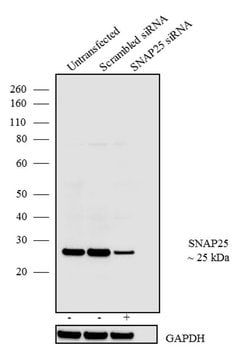
NOTCH2 Recombinant Rabbit Monoclonal Antibody (18H4L20), Invitrogen™
Manufacturer: Thermo Scientific
Select a Size
| Pack Size | SKU | Availability | Price |
|---|---|---|---|
| Each of 1 | 70-198-0-Each-of-1 | In Stock | ₹ 49,217.00 |
70-198-0 - Each of 1
In Stock
Quantity
1
Base Price: ₹ 49,217.00
GST (18%): ₹ 8,859.06
Total Price: ₹ 58,076.06
Antigen
NOTCH2
Classification
Recombinant Monoclonal
Concentration
0.5 mg/mL
Formulation
PBS with 0.09% sodium azide; pH 7.2
Gene Accession No.
Q04721
Gene Symbols
NOTCH2
Immunogen
Protein corresponding to Human NOTCH2 (aa 2100-2300)
Quantity
100 μg
Primary or Secondary
Primary
Target Species
Human
Product Type
Antibody
Isotype
IgG
Applications
Immunocytochemistry, Western Blot
Clone
18H4L20
Conjugate
Unconjugated
Gene
NOTCH2
Gene Alias
AGS2; AI853703; HJCYS; hN2; Motch B; N2; N2ECD; N2ICD; Neurogenic locus notch homolog protein 2; notch 2; Notch 2 extracellular truncation; Notch 2 intracellular domain; notch gene homolog 2; Notch homolog 2; notch receptor 2; Notch2
Host Species
Rabbit
Purification Method
Protein A
Regulatory Status
RUO
Gene ID (Entrez)
4853
Content And Storage
Store at 4°C short term. For long term storage, store at -20°C, avoiding freeze/thaw cycles.
Form
Liquid
Description
- This antibody is predicted to react with Monkey, Pig, sheep and Bovine
- Recombinant rabbit monoclonal antibodies are produced using in vitro expression systems
- The expression systems are developed by cloning in the specific antibody DNA sequences from immunoreactive rabbits
- Then, individual clones are screened to select the best candidates for production
- The advantages of using recombinant rabbit monoclonal antibodies include: better specificity and sensitivity, lot-to-lot consistency, animal origin-free formulations, and broader immunoreactivity to diverse targets due to larger rabbit immune repertoire
- Neurogenic locus notch homolog protein 2 (NOTCH2) is a highly conserved Notch signaling pathway protein
- NOTCH2 is a type 1 transmembrane protein with an extracellular domain consisting of multiple epidermal growth factor-like (EGF) repeats, and an intracellular domain consisting of multiple, different domain types
- NOTCH2 functions as a receptor for membrane-bound ligands Jagged1, Jagged2 and Delta1 to regulate cell-fate determination
- Defects in NOTCH2 are the cause of Alagille syndrome type 2 (ALGS2)
- Alagille syndrome is an autosomal dominant multisystem disorder defined clinically by hepatic bile duct paucity and cholestasis in association with cardiac, skeletal, and ophthalmologic manifestations
- There are characteristic facial features and less frequent clinical involvement of the renal and vascular systems.
Compare Similar Items
Show Difference
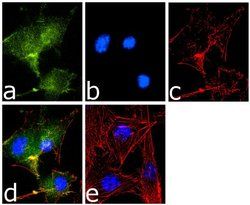
Antigen: NOTCH2
Classification: Recombinant Monoclonal
Concentration: 0.5 mg/mL
Formulation: PBS with 0.09% sodium azide; pH 7.2
Gene Accession No.: Q04721
Gene Symbols: NOTCH2
Immunogen: Protein corresponding to Human NOTCH2 (aa 2100-2300)
Quantity: 100 μg
Primary or Secondary: Primary
Target Species: Human
Product Type: Antibody
Isotype: IgG
Applications: Immunocytochemistry, Western Blot
Clone: 18H4L20
Conjugate: Unconjugated
Gene: NOTCH2
Gene Alias: AGS2; AI853703; HJCYS; hN2; Motch B; N2; N2ECD; N2ICD; Neurogenic locus notch homolog protein 2; notch 2; Notch 2 extracellular truncation; Notch 2 intracellular domain; notch gene homolog 2; Notch homolog 2; notch receptor 2; Notch2
Host Species: Rabbit
Purification Method: Protein A
Regulatory Status: RUO
Gene ID (Entrez): 4853
Content And Storage: Store at 4°C short term. For long term storage, store at -20°C, avoiding freeze/thaw cycles.
Form: Liquid
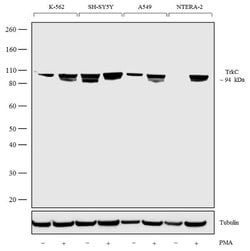
Antigen: TrkC
Classification: Recombinant Monoclonal
Concentration: 0.5 mg/mL
Formulation: PBS with 0.09% sodium azide; pH 7.2
Gene Accession No.: Q16288, Q6VNS1
Gene Symbols: Ntrk3
Immunogen: Protein corresponding to Human NTRK3 (aa 200-429)
Quantity: 100 μg
Primary or Secondary: Primary
Target Species: Human, Mouse
Product Type: Antibody
Isotype: IgG
Applications: Immunocytochemistry, Western Blot
Clone: 7H3L20
Conjugate: Unconjugated
Gene: Ntrk3
Gene Alias: AW125844; ETS related protein-neurotrophic receptor tyrosine kinase fusion protein; ETV6-NTRK3 fusion; gp145(trkC); GP145-TrkC; neural receptor protein-tyrosine kinase (trkC); neurotrophic receptor tyrosine kinase 3; Neurotrophic tyrosine kinase receptor type 3; neurotrophic tyrosine kinase, receptor, type 3; neurotrophin-3; NT-3 growth factor receptor; NTRK3; Ntrk3_tv3; TrkC; trk-C; trkC tyrosine kinase; tyrosine kinase receptor; tyrosine kinase receptor C
Host Species: Rabbit
Purification Method: Protein A
Regulatory Status: RUO
Gene ID (Entrez): 18213, 4916
Content And Storage: Store at 4°C short term. For long term storage, store at -20°C, avoiding freeze/thaw cycles.
Form: Liquid
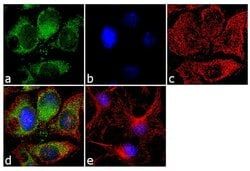
Antigen: Glutamine Synthetase
Classification: Recombinant Monoclonal
Concentration: 0.5 mg/mL
Formulation: PBS with 0.09% sodium azide; pH 7.2
Gene Accession No.: P09606, P15104, P15105
Gene Symbols: GLUL
Immunogen: Protein corresponding to Human GLUL (aa 2-373)
Quantity: 100 μg
Primary or Secondary: Primary
Target Species: Human, Mouse, Rat
Product Type: Antibody
Isotype: IgG
Applications: Immunocytochemistry, Immunohistochemistry (Frozen), Western Blot
Clone: 7H9L16
Conjugate: Unconjugated
Gene: GLUL
Gene Alias: cell proliferation-inducing protein 59; GLNA; GLNS; Glul; GLUL protein; Glutamate ammonia ligase; glutamate decarboxylase; glutamate-ammonia ligase; glutamate--ammonia ligase; glutamate-ammonia ligase (glutamine synthase); glutamate-ammonia ligase (glutamine synthetase); glutamine synthase; glutamine synthetase; Glutamine synthetase (glutamate-ammonia ligase); glutamine synthetase 1; glutamine synthetase I; GS; Palmitoyltransferase GLUL; PIG43; PIG59; Proliferation inducing protein 43; proliferation-inducing protein 43
Host Species: Rabbit
Purification Method: Protein A
Regulatory Status: RUO
Gene ID (Entrez): 14645, 24957, 2752
Content And Storage: Store at 4°C short term. For long term storage, store at -20°C, avoiding freeze/thaw cycles.
Form: Liquid