CD40 Monoclonal Antibody (1C10), Functional Grade, eBioscience™, Invitrogen™
Rat Monoclonal Antibody
Manufacturer: Fischer Scientific
The price for this product is unavailable. Please request a quote
Antigen
CD40
Concentration
1 mg/mL
Classification
Monoclonal
Form
Liquid
Regulatory Status
RUO
Formulation
PBS with no preservative; pH 7.2
Gene Alias
AI326936; B cell surface antigen CD40; B cell-associated molecule; B-cell surface antigen CD40; Bp50; CD antigen CD40; Cd40; CD40 antigen; CD40 antigen (TNF receptor superfamily member 5); CD40 antigen, TNF receptor superfamily member 5; CD40 molecule; CD40 molecule, TNF receptor superfamily member 5; CD40L receptor; CDw40; GP39; HIGM1; I79_006806; IGM; IMD3; Immunoglobulin M; ImmunoglobulinM; membrane protein CD40; MGC9013; p50; receptor for ligand CD154; sCD40; soluble CD40; T-BAM; T-cell differentiation antigen; Tnfrsf5; TRAP; tumor necrosis factor receptor superfamily member 5; tumor necrosis factor receptor superfamily, member 5
Gene Symbols
CD40
Primary or Secondary
Primary
Content And Storage
4° C
Gene
CD40
Clone
1C10
Applications
Flow Cytometry, Functional Assay
Conjugate
Functional Grade
Host Species
Rat
Target Species
Mouse
Gene Accession No.
P27512
Gene ID (Entrez)
21939
Isotype
IgG2a κ
Purification Method
Affinity chromatography
Product Type
Antibody
Description
- Description: The 1C10 monoclonal antibody reacts with mouse CD40, a 45-50 kDa type I transmembrane glycoprotein
- CD40 is a member of the TNFR family and is expressed by mouse B lymphocytes, follicular dendritic cells, thymic epithelium, and a subset of peripheral T cells
- CD40 regulates B cell development/maturation by inducing Ig isotype switching and in combination with other signals such as IL-4, protects B cells from surface Ig-induced apoptosis and promotes proliferation
- Interaction of CD40 with CD154 (gp39), its ligand on T cells, is important in T-B cell crosstalk and plays a role in costimulation and immune regulation
- The monoclonal antibody 1C10 is reported to have agonistic activity in vitro and in vivo
- Applications Reported: The 1C10 antibody has been reported for use in flow cytometric analysis
- It has also been reported in in vitro activation of B cells
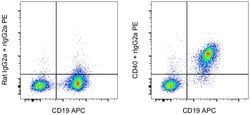
- Applications Tested: The 1C10 antibody has been tested by flow cytometric analysis of mouse splenocytes
- This can be used at less than or equal to 1 μg per test
- A test is defined as the amount (μg) of antibody that will stain a cell sample in a final volume of 100 μL
- Cell number should be determined empirically but can range from 10^5 to 10^8 cells/test
- It is recommended that the antibody be carefully titrated for optimal performance in the assay of interest
- Endotoxin: Less than 0.001 ng/ug antibody as determined by the LAL assay
- Storage and handling: Use in a sterile environment
- The CD40 antigen is a single chain glycoprotein that is known to be a member of the tumor necrosis factor/nerve growth factor superfamily and shows a significant homology to the Hodgkin's disease associated antigen, CD30
- CD40 is present on all B cells except plasma cells and is also found on some epithelial cells, carcinomas and lymphoid dendritic cells
- CD40 has been found to be essential in mediating a broad variety of immune and inflammatory responses including T cell-dependent immunoglobulin class switching, memory B cell development, and germinal center formation
- AT-hook transcription factor AKNA is reported to coordinately regulate the expression of CD40, which may be important for homotypic cell interactions
- Adaptor protein TNFR2 interacts with CD40 and serves as a mediator of the signal transduction
- The interaction of CD40 and its ligand is found to be necessary for amyloid-beta-induced microglial activation, and thus is thought to be an early event in Alzheimer disease pathogenesis
- Two alternatively spliced transcript variants of CD40 encoding distinct isoforms have been reported
- Diseases associated with CD40 dysfunction include Type 3 Hyper-Igm immunodeficiency and CD40 ligand deficiency.
Compare Similar Items
Show Difference
Antigen: CD40
Concentration: 1 mg/mL
Classification: Monoclonal
Form: Liquid
Regulatory Status: RUO
Formulation: PBS with no preservative; pH 7.2
Gene Alias: AI326936; B cell surface antigen CD40; B cell-associated molecule; B-cell surface antigen CD40; Bp50; CD antigen CD40; Cd40; CD40 antigen; CD40 antigen (TNF receptor superfamily member 5); CD40 antigen, TNF receptor superfamily member 5; CD40 molecule; CD40 molecule, TNF receptor superfamily member 5; CD40L receptor; CDw40; GP39; HIGM1; I79_006806; IGM; IMD3; Immunoglobulin M; ImmunoglobulinM; membrane protein CD40; MGC9013; p50; receptor for ligand CD154; sCD40; soluble CD40; T-BAM; T-cell differentiation antigen; Tnfrsf5; TRAP; tumor necrosis factor receptor superfamily member 5; tumor necrosis factor receptor superfamily, member 5
Gene Symbols: CD40
Primary or Secondary: Primary
Content And Storage: 4° C
Gene: CD40
Clone: 1C10
Applications: Flow Cytometry, Functional Assay
Conjugate: Functional Grade
Host Species: Rat
Target Species: Mouse
Gene Accession No.: P27512
Gene ID (Entrez): 21939
Isotype: IgG2a κ
Purification Method: Affinity chromatography
Product Type: Antibody
Antigen: CD44
Concentration: 1 mg/mL
Classification: Monoclonal
Form: Liquid
Regulatory Status: RUO
Formulation: PBS with no preservative; pH 7.2
Gene Alias: AU023126; AW121933; AW146109; Bovine CD44; CD44; CD44 antigen; CD44 antigen-like protein; CD44 molecule; CD44 molecule (Indian blood group); CD44 protein; CD44 variant; CD44A; CD44-like protein; CDW44; cell surface glycoprotein CD44; Cell surface glycoprotein CD44 (hyaluronate binding protein); cell-surface glycoprotein; chondroitin sulfate proteoglycan 8; CSPG8; ECMRIII; ECMR-III; Epican; extracellular matrix receptor III; extracellular matrix receptor-III; GP90 lymphocyte homing/adhesion receptor; HCELL; hematopoietic cell E- and L-selectin ligand; heparan sulfate proteoglycan; HERMES; Hermes antigen; homing function and Indian blood group system; HUTCH-I; hyaluronan receptor; Hyaluronate receptor; IN; LHR; Ly-24; lymphocyte antigen 24; lymphocyte surface antigen precursor CD44; MC56; MDU2; MDU3; METAA; MIC4; PGP I; Pgp1; PGP-1; PGPI; PGP-I; Phagocytic glycoprotein 1; phagocytic glycoprotein I; putative Bos taurus CD44; RHAMM; sCD 44; sCD44; soluble CD 44; soluble CD44
Gene Symbols: CD44
Primary or Secondary: Primary
Content And Storage: 4° C
Gene: CD44
Clone: IM7
Applications: Flow Cytometry, Functional Assay
Conjugate: Functional Grade
Host Species: Rat
Target Species: Human, Mouse
Gene Accession No.: P15379, P16070
Gene ID (Entrez): 12505, 960
Isotype: IgG2b κ
Purification Method: Affinity chromatography
Product Type: Antibody
Antigen: CD45R (B220)
Concentration: 1 mg/mL
Classification: Monoclonal
Form: Liquid
Regulatory Status: RUO
Formulation: PBS with no preservative; pH 7.2
Gene Alias: B220; Cd45; CD45 antigen; CD45R; GP180; Lca; L-CA; leucocyte common antigen; leukocyte common antigen; leukocyte common antigen A; leukocyte common antigen B; loc; LY5; Ly-5; Lymphocyte antigen 5; lymphocyte common antigen; Lyt-4; membrane tyrosine phosphatase; protein tyrosine phosphatase receptor type C; protein tyrosine phosphatase, receptor type C; protein tyrosine phosphatase, receptor type, C; protein tyrosine phosphatase, receptor type, c polypeptide; Protein tyrosine phosphatase, receptor-type, c polypeptide; Ptprc; Receptor-type tyrosine-protein phosphatase C; RT7; T200; T200 glycoprotein; T200 leukocyte common antigen
Gene Symbols: PTPRC
Primary or Secondary: Primary
Content And Storage: 4° C
Gene: PTPRC
Clone: RA3-6B2
Applications: Flow Cytometry, Functional Assay
Conjugate: Functional Grade
Host Species: Rat
Target Species: Human, Mouse
Gene Accession No.: P06800, P08575
Gene ID (Entrez): 19264, 5788
Isotype: IgG2a κ
Purification Method: Affinity chromatography
Product Type: Antibody
