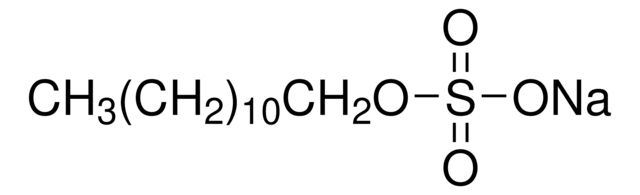
Sodium dodecyl sulfate
Manufacturer: Sigma Aldrich
CAS Number: 151-21-3
Synonym(S): Dodecyl sodium sulfate, Dodecyl sulfate sodium salt, Lauryl sulfate sodium salt, SDS, Sodium lauryl sulfate
Select a Size
| Pack Size | SKU | Availability | Price |
|---|---|---|---|
| 25 G | 436143-25-G | In Stock | ₹ 3,670.00 |
| 100 G | 436143-100-G | In Stock | ₹ 4,200.00 |
436143 - 25 G
In Stock
Quantity
1
Base Price: ₹ 3,670.00
GST (18%): ₹ 660.60
Total Price: ₹ 4,330.60
grade
ACS reagent
Quality Level
200
description
anionic 62
Assay
≥99.0%
form
solid
mol wt
288.38 g/mol
impurities
≤0.06 meq/g Titr. Base≥96.0% fatty alcohols<4.0% unsulfated alcohols
loss
≤1.0% loss on drying
mp
204-207 °C (lit.)
solubility
H2O: soluble 1 gm in 10 ml (opalescent solution)
Other Options
Related Products
Description
- General description: Sodium dodecyl sulfate (SDS), also known as sodium lauryl sulfate, is a versatile anionic surfactant with a broad range of applications in cell biology, biochemistry, and various industries. Its amphiphilic nature, characterized by a hydrophobic hydrocarbon tail and a hydrophilic sulfate head group, makes it an effective detergent capable of solubilizing and denaturing proteins, lipids, and other hydrophobic molecules.In protein biochemistry, SDS plays a pivotal role in protein extraction and SDS-PAGE (sodium dodecyl sulfate-polyacrylamide gel electrophoresis). Its ability to denature proteins by disrupting their secondary and tertiary structures allows for their uniform migration through a polyacrylamide gel matrix based on their molecular weight. This technique, SDS-PAGE, has become an indispensable tool for analyzing protein size and purity.Beyond protein analysis, SDS also finds applications in nucleic acid extraction and hybridization techniques. Its detergent properties aid in the lysis of cells and the solubilization of cellular components, facilitating the extraction of DNA and RNA. This makes SDS a valuable reagent in various molecular biology protocols, including PCR (polymerase chain reaction) and Southern blotting. Sodium dodecyl sulfate stands as a versatile and widely used surfactant with a diverse range of applications due to its ability to solubilize, denature, and separate biological molecules for cell biology and biochemical research.
- Application: Sodium dodecyl sulfate was used as a test compound for studying that whether Bacillus amyloliquefaciens KPS46 can induce priming, signaling, protein production as well as systemic protection in soybean (Glycine max L.) against several diseases.[1]
- Biochem/physiol Actions: Sodium dodecyl sulfate (SDS) is an anionic detergent that can form complexes with protein through hydrophobic interactions. Studies have reported that the hydrodynamic functions of protein-SDS complexes are governed by the length of their polypeptide chains. Thus, SDS-based electrophoretic techniques can separate protein molecules based on their molecular weights.[2] Additionally, SDS can solubilize cell membranes and can extract membrane-bound proteins.[3]
- Features and Benefits: Highly versatile surfactant for your molecular biology and biochemical researchTested to confirm low levels of heavy metal contamination, ensuring suitability for various applications
- Other Notes: For additional information on our range of Biochemicals, please complete this form.
SAFETY INFORMATION
Pictograms
Signal Word
Danger
Hazard Statements
Precautionary Statements
P210 - P273 - P280 - P301 + P312 - P304 + P340 + P312 - P305 + P351 + P338
Hazard Classifications
Acute Tox. 4 Inhalation - Acute Tox. 4 Oral - Aquatic Chronic 3 - Eye Dam. 1 - Flam. Sol. 2 - Skin Irrit. 2 - STOT SE 3
Target Organs
Respiratory system
WGK
WGK 2
Flash Point(F)
338.0 °F
Flash Point(C)
170 °C
Personal Protective Equipment
dust mask type N95 (US), Eyeshields, Gloves