14-564-337
Myogenin Monoclonal Antibody (F5D), eBioscience™, Invitrogen™
Manufacturer: Invitrogen
Select a Size
| Pack Size | SKU | Availability | Price |
|---|---|---|---|
| Each of 1 | 14-564-337-Each-of-1 | In Stock | ₹ 1,22,108.00 |
14-564-337 - Each of 1
In Stock
Quantity
1
Base Price: ₹ 1,22,108.00
GST (18%): ₹ 21,979.44
Total Price: ₹ 1,44,087.44
Antigen
Myogenin
Classification
Monoclonal
Concentration
0.5 mg/mL
Formulation
PBS with 0.09% sodium azide; pH 7.2
Gene Accession No.
P12979, P15173, P20428
Gene Symbols
MYOG
Purification Method
Affinity chromatography
Regulatory Status
RUO
Gene ID (Entrez)
17928, 29148, 4656, 490224
Content And Storage
4° C
Form
Liquid
Applications
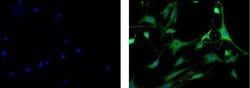
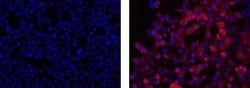
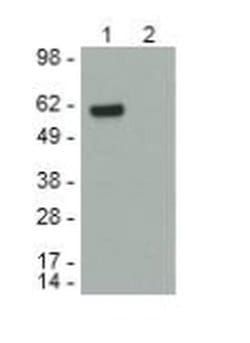
Immunocytochemistry, Western Blot
Clone
F5D
Conjugate
Unconjugated
Gene
MYOG
Gene Alias
bHLHc3; Class C basic helix-loop-helix protein 3; MYF4; Myf-4; myo; MYOD1-related protein; MYOG; Myogenic factor 4; Myogenic factor-4; myogenin; myogenin (myogenic factor 4)
Host Species
Mouse
Quantity
2 mg
Primary or Secondary
Primary
Target Species
Canine, Human, Mouse, Rat
Product Type
Antibody
Isotype
IgG1
Related Products


Description
- This F5D MAb reacts with human, mouse, dog, and rat myogenin, a 34-kDa transcription factor
- Expressed in skeletal and heart muscle, myogenin is a member of the MyoD family of basic-helix-loop-helix proteins, which also includes MyoD, Myf5, and MRF4
- This transcription factor interacts with other helix-loop-helix proteins, which may or may not be muscle-specific
- Myogenin plays a significant role in myogenic differentiation, even directing nonmuscle cells to the myogenic lineage
- Transforming growth factor-beta (TGFb) and bone morphogenetic protein-2 (BMP2) inhibit myogenin transcriptional activity
- Predominantly residing within the nucleus, the subcellular localization of myogenin has been shown to be dependent on differentiation status and cell density
- For instance, trafficking of myogenin between the nucleus and cytoplasm has been reported during skeletal muscle differentiation to mediate transcription control
- Myogenin is a muscle-specific transcription factor that can induce myogenesis in a variety of cell types in tissue culture
- It is a member of a large family of proteins related by sequence homology, the helix-loop-helix proteins
- It is essential for the development of functional skeletal muscle.