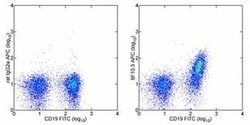
CD178 (Fas Ligand) Monoclonal Antibody (MFL3), APC, eBioscience™, Invitrogen™
Armenian Hamster Monoclonal Antibody
Manufacturer: Fischer Scientific
The price for this product is unavailable. Please request a quote
Antigen
CD178 (Fas Ligand)
Concentration
0.2 mg/mL
Classification
Monoclonal
Form
Liquid
Regulatory Status
RUO
Formulation
PBS with 0.09% sodium azide; pH 7.2
Gene Alias
ADAM10-processed FasL form; ALPS1B; APL; Apoptosis (APO 1) antigen ligand 1; apoptosis (APO-1) antigen ligand 1; Apoptosis (APO-1) antigen ligand 1 (Fas antigen ligand); apoptosis antigen ligand; APT1LG1; APTL; CD178; CD178 antigen; CD95 ligand; CD95 ligand protein;Generalized lymphoproliferative disease (Gld); Cd95l; CD95-L; CD95L protein; fas antigen ligand; Fas ligand; Fas ligand (TNF superfamily, member 6); Fasl; Fas-L; FasL ICD; FasL intracellular domain; Faslg; Fas-LG; generalized lymphoproliferative disease; gld; mutant tumor necrosis factor family member 6; Receptor-binding FasL ectodomain; sFasL; Soluble Fas ligand; soluble form; SPA; SPPL2A-processed FasL form; TNFL; Tnfsf6; TNLG1A; Tumor necrosis factor (ligand) superfamily member 6; Tumor necrosis factor (ligand) superfamily member 6 (apoptosis (APO-1) antigen ligand 1) (Fas antigen ligand); Tumor necrosis factor (ligand) superfamily, member 6 (apoptosis (APO-1) antigen ligand 1) (Fas antigen ligand); Tumor necrosis factor ligand; tumor necrosis factor ligand 1A; tumor necrosis factor ligand superfamily member 6; Tumor necrosis factor ligand superfamily member 6 (TNFL6 / TNFSF6); Tumor necrosis factor ligand superfamily member 6, membrane form; Tumor necrosis factor ligand superfamily member 6, soluble form
Gene Symbols
Fasl
Primary or Secondary
Primary
Content And Storage
4° C, store in dark, DO NOT FREEZE!
Gene
Fasl
Clone
MFL3
Applications
Flow Cytometry
Conjugate
APC
Host Species
Armenian Hamster
Target Species
Mouse
Gene Accession No.
P41047
Gene ID (Entrez)
14103
Isotype
IgG
Purification Method
Affinity chromatography
Product Type
Antibody
Description
- Description: The MFL3 monoclonal antibody reacts with mouse Fas (CD95) Ligand, a 40 kDa type II transmembrane glycoprotein
- FasL is a member of the TNF family and is expressed by mouse activated T cells
- The interaction of FasL with its receptor CD95 induces Fas-mediated killing
- It has been reported that the human FasL antigen is cleaved from the surface by matrix metalloproteinases (MMPs), resulting in a 26 kDa soluble form
- The degree of sensitivity for the mouse antigen to MMPs has not been reported
- Applications Tested: This MFL3 antibody has been tested by flow cytometric analysis of mouse FasL-transfected cells
- This can be used at less than or equal to 0.25 μg per test
- A test is defined as the amount (μg) of antibody that will stain a cell sample in a final volume of 100 μL
- Cell number should be determined empirically but can range from 10^5 to 10^8 cells/test
- It is recommended that the antibody be carefully titrated for optimal performance in the assay of interest
- Excitation: 633-647 nm; Emission: 660 nm; Laser: Red Laser
- Filtration: 0.2 μm post-manufacturing filtered
- CD178 (Fas ligand, FasL) is a type-II-membrane protein, whose N-terminus is in the cytoplasm and its C-terminal region extends into the extracellular space
- Its receptor, FasR, is a cell-surface-type-I-membrane protein and a member of the tumor necrosis factor (TNF) and nerve growth factor (NGF) receptor family
- As a member of the TNF-cytokine family CD178 induces apoptosis when interacting with FasR
- CD178 may exist as either membrane bound (45 kD) or soluble forms (26 kD)
- The soluble protein can be released from cells upon cleavage by metalloproteinases
- Binding of CD178 to Fas leads to oligomerization of the receptor and triggers apoptotic cell death through the interaction of other proteins
- CD178 is predominantly expressed in activated T-lymphocytes and natural killer (NK) cells also it is expressed in the tissues of immune-privilege sites such as testis and eye
- CD178 expression is also reported in various tissues as thymus, liver, ovary, lung, heart and kidney
- It is assumed that induction of apoptosis through CD178 is predominantly involved in anti-viral immune responses
- CD178 is a cell surface molecule belonging to the tumor necrosis factor family, binds to its receptor Fas, thus inducing apoptosis
- Various cells express FAS, where CD178 is expressed predominantly on activated T cells
- FAS and CD178 are involved in the down-regulation of immune reactions as well as T cell-mediated cytotoxicity
- CD178 concentration has also been shown to be associated with atherosclerosis and inflammatory disease, in patients with hypertension
- The Fas/ CD178 system has been shown to play a role in a number of human diseases, for example AIDS, hepatitis or cancer.
Compare Similar Items
Show Difference

Antigen: CD178 (Fas Ligand)
Concentration: 0.2 mg/mL
Classification: Monoclonal
Form: Liquid
Regulatory Status: RUO
Formulation: PBS with 0.09% sodium azide; pH 7.2
Gene Alias: ADAM10-processed FasL form; ALPS1B; APL; Apoptosis (APO 1) antigen ligand 1; apoptosis (APO-1) antigen ligand 1; Apoptosis (APO-1) antigen ligand 1 (Fas antigen ligand); apoptosis antigen ligand; APT1LG1; APTL; CD178; CD178 antigen; CD95 ligand; CD95 ligand protein;Generalized lymphoproliferative disease (Gld); Cd95l; CD95-L; CD95L protein; fas antigen ligand; Fas ligand; Fas ligand (TNF superfamily, member 6); Fasl; Fas-L; FasL ICD; FasL intracellular domain; Faslg; Fas-LG; generalized lymphoproliferative disease; gld; mutant tumor necrosis factor family member 6; Receptor-binding FasL ectodomain; sFasL; Soluble Fas ligand; soluble form; SPA; SPPL2A-processed FasL form; TNFL; Tnfsf6; TNLG1A; Tumor necrosis factor (ligand) superfamily member 6; Tumor necrosis factor (ligand) superfamily member 6 (apoptosis (APO-1) antigen ligand 1) (Fas antigen ligand); Tumor necrosis factor (ligand) superfamily, member 6 (apoptosis (APO-1) antigen ligand 1) (Fas antigen ligand); Tumor necrosis factor ligand; tumor necrosis factor ligand 1A; tumor necrosis factor ligand superfamily member 6; Tumor necrosis factor ligand superfamily member 6 (TNFL6 / TNFSF6); Tumor necrosis factor ligand superfamily member 6, membrane form; Tumor necrosis factor ligand superfamily member 6, soluble form
Gene Symbols: Fasl
Primary or Secondary: Primary
Content And Storage: 4° C, store in dark, DO NOT FREEZE!
Gene: Fasl
Clone: MFL3
Applications: Flow Cytometry
Conjugate: APC
Host Species: Armenian Hamster
Target Species: Mouse
Gene Accession No.: P41047
Gene ID (Entrez): 14103
Isotype: IgG
Purification Method: Affinity chromatography
Product Type: Antibody

Antigen: iNOS
Concentration: 0.2 mg/mL
Classification: Monoclonal
Form: Liquid
Regulatory Status: RUO
Formulation: PBS with 0.09% sodium azide; pH 7.2
Gene Alias: Hepatocyte NOS; hepatocytes; HEP-NOS; inducible nitric oxide synthase; inducible NO synthase; Inducible NOS; iNos; i-NOS; Inosl; MAC-NOS; macrophage NOS; nitric oxide synthase 2; nitric oxide synthase 2, inducible; nitric oxide synthase 2, inducible, macrophage; nitric oxide synthase 2A (inducible, hepatocytes); nitric oxide synthase, inducible; nitric oxide synthase, macrophage; nitric oxide synthase-inducible; NOS; NOS type II; NOS, type II; Nos2; Nos-2; Nos2a; NOS-II; OTTMUSP00000000202; peptidyl-cysteine S-nitrosylase NOS2
Gene Symbols: Nos2
Primary or Secondary: Primary
Content And Storage: 4° C, store in dark, DO NOT FREEZE!
Gene: Nos2
Clone: CXNFT
Applications: Flow Cytometry
Conjugate: APC
Host Species: Rat
Target Species: Mouse
Gene Accession No.: P29477
Gene ID (Entrez): 18126
Isotype: IgG2a κ
Purification Method: Affinity chromatography
Product Type: Antibody
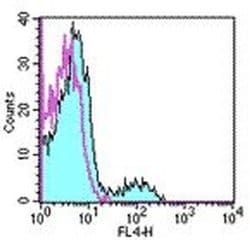
Antigen: NK1.1
Concentration: 0.2 mg/mL
Classification: Monoclonal
Form: Liquid
Regulatory Status: RUO
Formulation: PBS with 0.09% sodium azide; pH 7.2
Gene Alias: AI462337; CD161; CD161 antigen-like family member B; CD161 antigen-like family member C; CD161b; CD161c; EMBL:AAQ11375.1}; Inhibitory receptor NKR-P1B; killer cell lectin-like receptor subfamily A member 1C; killer cell lectin-like receptor subfamily B member 1B; killer cell lectin-like receptor subfamily B member 1B allele A; Killer cell lectin-like receptor subfamily B member 1B allele B; killer cell lectin-like receptor subfamily B member 1B allele C; killer cell lectin-like receptor subfamily B member 1C; killer cell lectin-like receptor subfamily B member 1D; killer cell lectin-like receptor subfamily B member 1F; KLRB1; Klrb1b; klrb1b {ECO:0000312; Klrb1c; Klrb1d; Klrb1f; klrb1f {ECO:0000250; Ly55; Ly-55; Ly55b; ly-55b; Ly55c; ly-55c; Ly55d; Ly-55d; Ly59; Ly-59; lymphocyte antigen 55 complex, locus B; lymphocyte antigen 55 complex, locus C; lymphocyte antigen 55 complex, locus D; lymphocyte antigen 55b; lymphocyte antigen 55c; Lymphocyte antigen 55d; lymphocyte antigen 59; MGC163757; MGC163759; natural killer cell receptor protein NKR-P1B; natural killer cell receptor protein NKR-P1C; natural killer cell receptor-P1; natural killer cell surface protein NKR-P1B allele B6; Natural killer cell surface protein NKR-P1B allele RNK/SD/BN/F344; natural killer cell surface protein NKR-P1B allele SJL/BALB; natural killer cell surface protein NKR-P1B allele TO; natural killer cell surface protein NKR-P1F; Natural killer cell surface protein P1-40; natural killer cell-associated antigen 1; natural killer cells; nk cells; Nk1; Nk-1; NK1.1; Nk1.2; Nk-1.2; NKRP1; NK-RP1; NKR-P1 34; NKR-P1 40; NKR-P1.9; NKRP140; Nkrp1b; NKR-P1B; Nkrp1-b; NKR-P1B protein; Nkrp1c; NKR-P1C; Nkrp1d; NKR-P1D; Nkrp1f; NKR-P1F; RGD:2975}; UniProtKB:Q8VD98}
Gene Symbols: Klrb1b, Klrb1c
Primary or Secondary: Primary
Content And Storage: 4° C, store in dark, DO NOT FREEZE!
Gene: __
Clone: PK136
Applications: Flow Cytometry
Conjugate: APC
Host Species: Mouse
Target Species: Mouse
Gene Accession No.: P27812, P27814
Gene ID (Entrez): 17059, 80782
Isotype: IgG2a κ
Purification Method: Affinity chromatography
Product Type: Antibody